Rejuran S Acne Scar Treatment:
What It Really Does
Rejuran S acne scar treatment is a targeted
polynucleotide approach used for selected depressed acne scars.
But not every acne scar needs the same treatment. Rolling,
boxcar and ice pick scars differ in structure, which is why
proper scar assessment matters before deciding where Rejuran S
may fit.
Doctor-led guide
Atrophic acne scars
Polynucleotide treatment
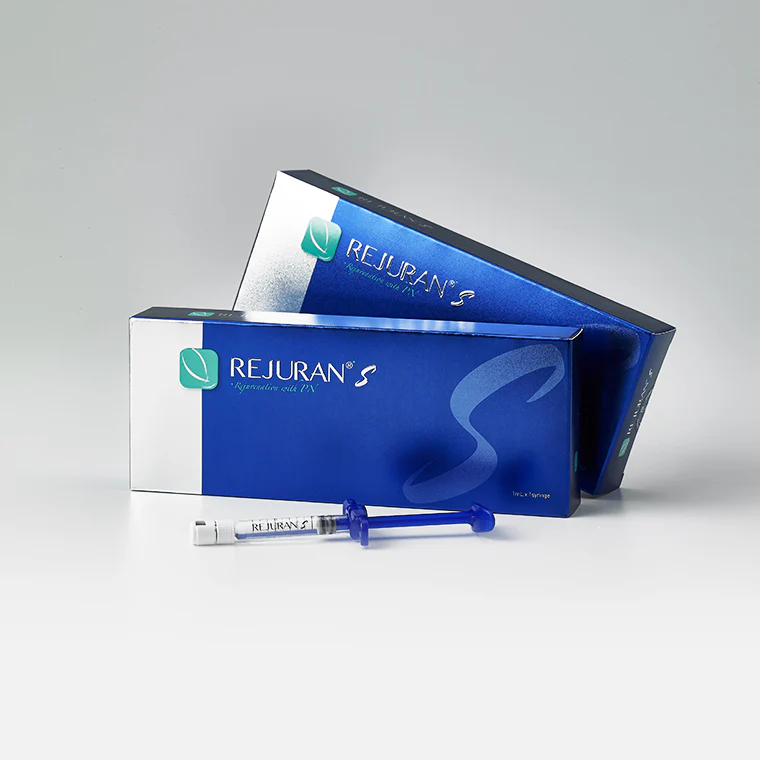
The type and structure of the acne scar should be assessed first.
01
Treatment type
Polynucleotide injectable
02
Main focus
Selected atrophic scars
03
First step
Identify the scar type
04
Treatment strategy
Often part of a combination plan
Start here
What Is Rejuran S?
Rejuran S is a polynucleotide-based injectable used in
targeted treatment plans for selected depressed or damaged
areas of skin, including some types of atrophic acne scars.
Polynucleotides, commonly shortened to PN,
are purified chains of nucleotides used in regenerative
aesthetic medicine as part of treatments aimed at supporting
skin quality and tissue remodelling.
Unlike a general facial skin-booster treatment, Rejuran S
may be administered more selectively into or around scarred
areas where targeted treatment is considered appropriate.
This distinction matters because acne scars are not all
identical. Their shape, depth, tethering and surrounding
skin condition can influence which treatment approach
makes the most sense.
Patients comparing Rejuran S with broader injectable
rejuvenation treatments can also read our
complete skin booster treatment guide
.
Acne scars are not one diagnosis.
The visible depression is only part of the story —
what happens underneath the skin also matters.
Treat the scar pattern, not simply the scar name
Know your scars
Which Acne Scar Type Do You Have?
Rolling, boxcar and ice pick scars have different shapes
and underlying structures. Many people have a mixture of
several scar types on the same area of the face.
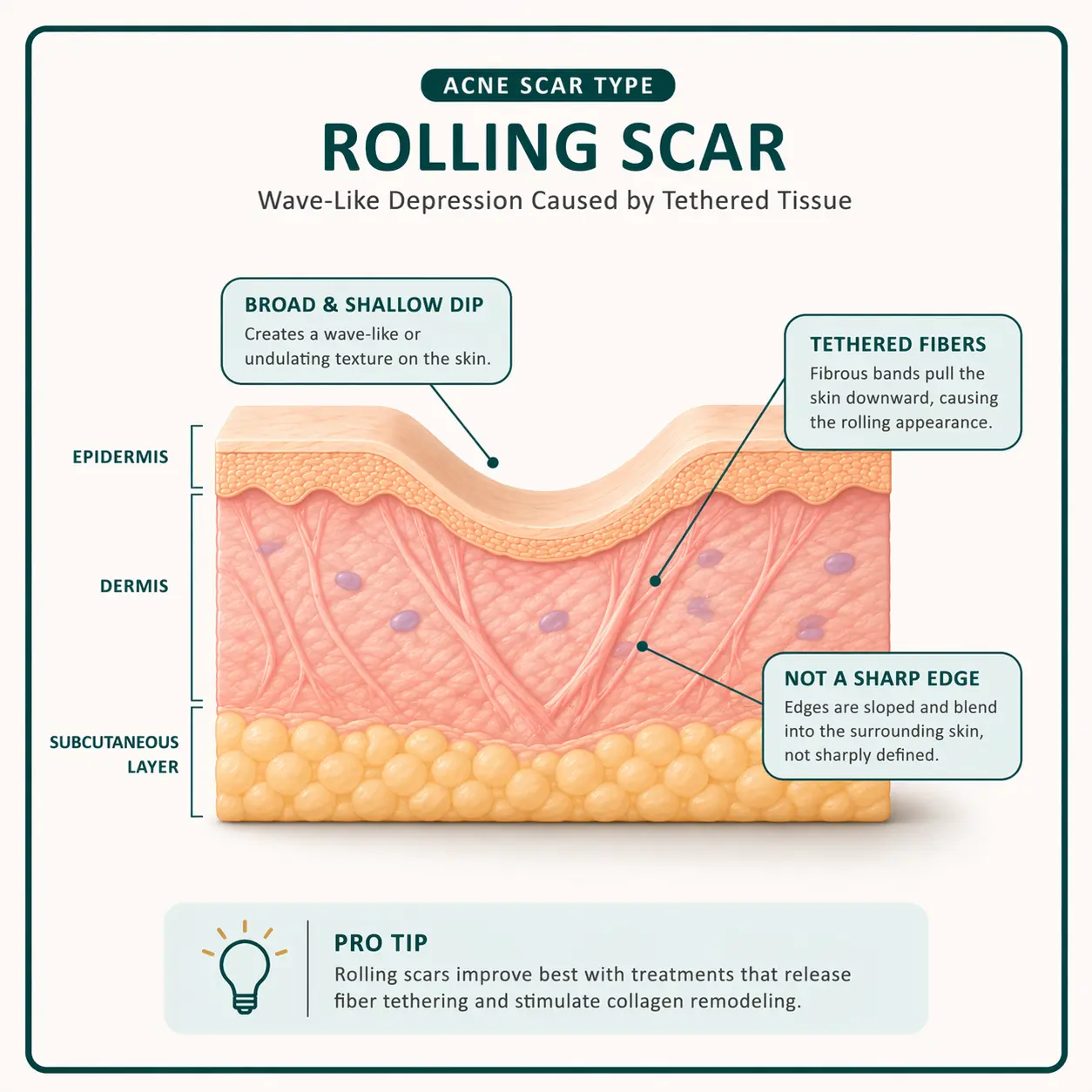
Broad depression
Rolling Scars
Rolling scars create soft, wave-like depressions.
Fibrous bands underneath the skin may tether the
surface downward. When tethering is important,
subcision may need to address it directly.
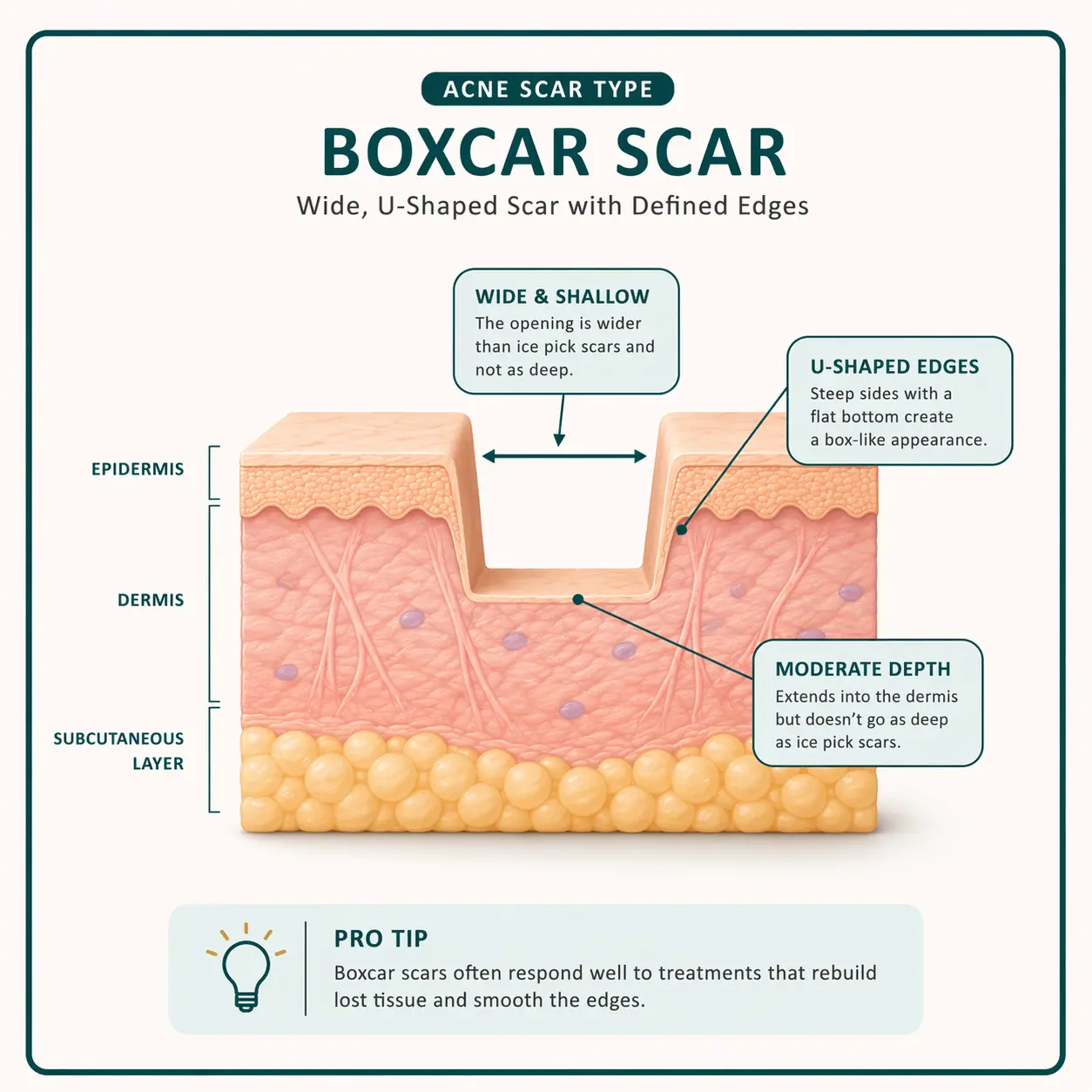
Defined depression
Boxcar Scars
Boxcar scars have more defined edges and may be
shallow or deep. Treatment can involve resurfacing,
focal procedures, injectables or a combination
depending on scar depth.
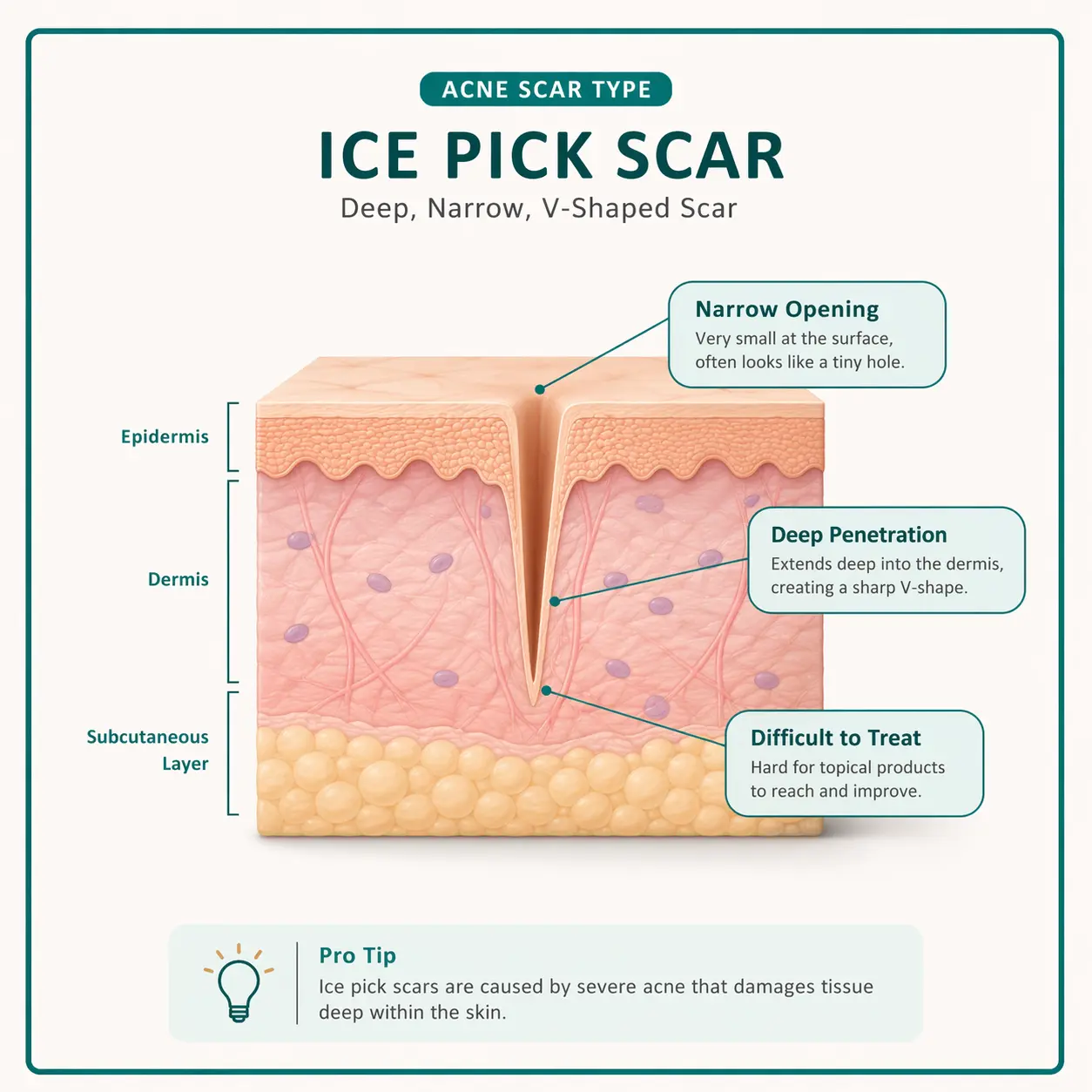
Narrow & deep
Ice Pick Scars
Ice pick scars extend deeper into the skin through
a narrow channel. Focal treatments such as TCA CROSS
may be considered when this architecture is present.
Not sure which type you have?
Read our
complete acne scar treatment guide
.
Treatment role
How Rejuran S Acne Scar Treatment May Help
Rejuran S acne scar treatment may be
discussed when targeted treatment of scarred tissue and
skin quality forms part of the overall acne-scar plan.
It is important to understand that Rejuran S does not
mechanically release a tethered scar or directly remove
a deep ice pick channel. Its role is different.
01
Targeted treatment
Selected depressed areas can be treated individually
rather than distributing product across the entire face.
02
Scarred skin quality
Polynucleotide treatment may form part of a strategy
focused on supporting dermal quality and remodelling.
03
Combination treatment
Rejuran S can be discussed alongside procedures
that target scar tethering, deep scar channels
or uneven skin texture.
04
Progressive improvement
Treatment is better viewed as part of a gradual
remodelling process rather than an instant correction.
How to think about it
How Does Rejuran S Acne Scar Treatment Fit Into a Plan?
The most useful approach is to first identify the scar,
then identify the structural problem, and only then choose
the appropriate treatment.
1
Identify the scar
Is the scar rolling, boxcar, ice pick or part of a mixed
scar pattern?
→
2
Identify the mechanism
Is the skin tethered underneath, is the scar very deep,
or is surface texture the main concern?
→
3
Match the treatment
Rejuran S becomes relevant when targeted polynucleotide
treatment fits the scar pattern and treatment objective.
Realistic expectations matter.
Research into polynucleotides for atrophic acne scars is
encouraging, but outcomes vary. Rejuran S should not be
described as a treatment that guarantees complete removal
of acne scars.
Match the mechanism
Rejuran S vs Other Acne Scar Treatments
Different acne-scar procedures target different structural
problems. They should not be viewed as interchangeable.
| Scar concern | Rejuran S | Other treatment that may matter |
|---|---|---|
| Selected depressed scar tissue |
Targeted PN treatment may form part of a plan focused on scarred tissue and skin quality. |
Resurfacing or focal scar treatment may also be required. |
| Tethered rolling scars | May complement the overall scar-treatment plan. |
Subcision may be used to release selected fibrous bands beneath the skin. |
| Deep ice pick scars |
Rejuran S alone may not adequately address their narrow and deep architecture. |
TCA CROSS may be considered for selected deep focal scars. |
| Uneven skin texture | May support a broader remodelling strategy. |
Fractional resurfacing may more directly target surface irregularity. |
| Brown acne marks | Rejuran S is not primarily a pigmentation treatment. |
Pigment-directed skincare, chemical peels or selected laser treatments may be more relevant. |
Combination strategy
Why Acne Scar Treatment Often Uses More Than One Approach
One cheek can contain rolling scars, boxcar scars,
ice pick scars and post-acne pigmentation at the same time.
A combination plan allows each problem to be approached
according to its structure.
Subcision
Subcision works underneath selected scars to release
fibrous bands that pull the skin downward.
This means subcision and Rejuran S can have different
roles within the same acne-scar strategy.
TCA CROSS
TCA CROSS delivers a controlled chemical treatment
directly into selected deep scars.
It may be particularly relevant when narrow ice pick
scars require focal treatment.
Fractional Laser
Fractional resurfacing can address broader surface
irregularity, scar edges and uneven skin texture.
Injectable and laser treatments may be staged according
to the treatment plan and skin recovery.
At the clinic
What Happens During Rejuran S Acne Scar Treatment?
The exact technique varies according to the scar pattern,
so the process begins with assessment rather than injection.
Scar assessment
The doctor evaluates scar type, depth, tethering,
active acne, pigmentation and overall skin condition.
Treatment planning
Selected scars suitable for Rejuran S are identified.
Other scars may require different procedures.
Targeted injection
After skin preparation and numbing where appropriate,
treatment is administered according to the planned area.
Review
Remaining scar depth, texture and tethering can be
reassessed before planning subsequent treatment.
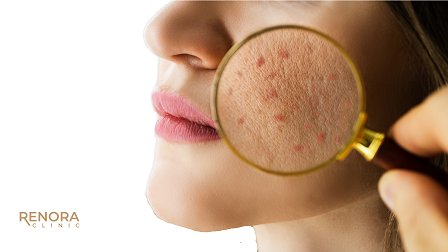
Recovery & expectations
Recovery After Rejuran S Treatment
Rejuran S involves injections, so temporary injection-site
reactions can occur. Any scar-quality improvement should be
assessed progressively rather than immediately after treatment.
Immediately afterwards
Small raised areas, redness, tenderness, swelling or
pinpoint bleeding may occur at injection sites.
Early recovery
Mild swelling, injection marks or bruising may remain
visible while the area settles.
Following weeks
Changes in scar quality, where they occur, are generally
evaluated progressively.
Follow-up
Remaining scars can be reassessed before deciding whether
further PN treatment or another procedure should follow.
Evidence
What Does Research Say About Polynucleotides for Acne Scars?
Clinical research has investigated highly purified
polynucleotide injections for atrophic acne scars.
A preliminary prospective randomised placebo-controlled
study published in the Aesthetic Surgery Journal
reported improvement in the polynucleotide treatment group
during follow-up.
The study was relatively small, however. Larger and more
standardised studies remain useful for understanding the
magnitude, consistency and duration of improvement.
For this reason, Rejuran S acne scar treatment
should be discussed as one possible component of acne-scar
management rather than a treatment that guarantees scars
will disappear completely.
Randomised study of highly purified polynucleotides
for moderate-to-severe acne scars
PubMed ↗
Polynucleotide-based treatment and scar management
PubMed ↗
Who May Consider Rejuran S for Acne Scars?
Suitability cannot be decided from a product name alone.
The scar itself needs to be assessed.
It may be worth discussing when…
- You have selected depressed or atrophic acne scars
- Scarred skin quality forms part of your concern
- Your active acne is reasonably controlled
- You understand improvement is gradual
- You are open to combination treatment when appropriate
Assessment is especially important when…
- Deep ice pick scars dominate the area
- Rolling scars appear strongly tethered
- Active inflammatory acne remains present
- Raised or keloid-type scars are present
- Your medical history or medication needs review
Explore Related Renora Guides
Acne Scar Treatment
Learn how rolling, boxcar and ice pick scars differ
and why different scars may need different procedures.
Explore acne scar treatment →
Skin Rejuvenation
Skin Booster Guide
Compare Rejuran, Polyphil Next, Plenhyage, Revok50,
Plinest and other injectable rejuvenation treatments.
Read skin booster guide →
Active Acne
Acne Treatment
Understand why controlling active inflammatory acne
may be important before significant scar treatment begins.
Explore acne treatment →
Frequently asked
Rejuran S Acne Scar Treatment FAQ
What is Rejuran S acne scar treatment?
Rejuran S acne scar treatment uses a polynucleotide
injectable in selected scarred or depressed areas of
skin. Whether it is suitable depends on scar type,
depth and the overall treatment plan.
Can Rejuran S completely remove acne scars?
Complete scar removal should not be guaranteed.
Rejuran S may form part of a treatment plan for
selected acne scars, but improvement varies according
to scar structure and individual response.
Is Rejuran S suitable for rolling scars?
It may be discussed for selected rolling scars.
However, scars tethered by fibrous bands may require
subcision to directly release the underlying tether.
Is Rejuran S suitable for boxcar scars?
Selected boxcar scars may be considered depending on
their depth and structure. Resurfacing or other focal
scar treatments may also be needed.
Is Rejuran S suitable for ice pick scars?
Deep ice pick scars have narrow, deep architecture.
Focal procedures such as TCA CROSS may therefore be
more directly relevant for selected scars.
What is the difference between Rejuran S and Rejuran Healer?
Rejuran Healer is generally discussed more broadly
for facial skin rejuvenation, while Rejuran S is used
in a more targeted manner for selected depressed or
scarred areas.
Can Rejuran S be combined with subcision?
Combination treatment may be considered because the
treatments address different aspects of scarring.
Subcision targets selected fibrous tethering underneath
the skin, while Rejuran S has a different role.
Can Rejuran S be combined with fractional laser?
Injectable and resurfacing procedures may form part of
the same overall acne-scar plan. Treatment timing depends
on scar pattern, skin condition and recovery.
Is there downtime after Rejuran S?
Temporary redness, swelling, tenderness, injection marks
or bruising may occur. Recovery varies between individuals.
How many Rejuran S sessions will I need?
There is no universal number of sessions.
Treatment planning depends on scar severity, technique,
response and whether other scar procedures are being used.
Should active acne be treated before acne scars?
In many cases, controlling ongoing inflammatory acne
is an important first step because new breakouts can
continue producing new scars during scar treatment.
Not Every Acne Scar Needs the Same Treatment.
If you are considering
Rejuran S acne scar treatment
,
a Renora doctor can assess whether your scars are rolling,
boxcar, ice pick or mixed and discuss where Rejuran S,
subcision, TCA CROSS, resurfacing or a staged combination
may fit.
This article is provided for general educational purposes and
does not replace individual medical consultation. Injectable
treatments may cause temporary redness, swelling, bruising,
tenderness, bleeding, injection-site reactions, infection and
other complications. Acne-scar treatment outcomes vary according
to scar type, skin characteristics, treatment technique and
individual response.
Add Comment